This site is under (very slow) construction
About Me
Professional Career
I currently work in the energy sector in Cyber Defense, with more than 25 years of experience spanning cybersecurity & industrial control systems (ICS/OT) for critical infrastructure operations across both offshore and onshore environments. I got my BS in Electrical Engineering in 2004 following many years working in fire & gas detection & systems integration. In the years that followed, I leaned into the control systems industry and had many great mentors to follow and ended up getting to travel the world a bit for various projects. I had a brief (5 year) foray into land-based SCADA systems, which got me a healthy dose of spread spectrum frequency hopping radio mesh networks, then went back into the offshore world for a few more years. I wasn't a huge fan of the offshore life, so when I saw an opportunity to escape, I moved into the cyber discipline and drank from that firehose for a couple of years before moving into a defense operations leadership role. I do miss the helicopter rides, even though I sometimes got airsick; I am an aviation enthusiast. I don't trust myself behind the controls of an aircraft, so I'm relegated to ground-based hobbies. Flight simming, model building, & now ham radio.
Oil & Gas, Control Systems & Technology Principles
Working in industrial environments teaches you very quickly that safety, reliability, and preparation matter. In the oil & gas and control systems world, small mistakes can have very large consequences, which creates a mindset centered around:
continuous learning
operational discipline
troubleshooting under pressure
risk awareness
teamwork
practical problem solving
That mindset carries over directly into amateur radio.
Whether it’s RF interference, antenna tuning, grounding, propagation, or station integration, I enjoy understanding how systems interact, identifying root causes, testing solutions, and improving performance over time.
I’ve always been drawn toward technology that blends engineering, communication, experimentation, and real-world operation — which is one of the reasons amateur radio became such an interesting hobby for me.
Ham Radio
I’m still relatively new to amateur radio, which is honestly part of what makes the hobby exciting. There’s always another antenna to test, another operating mode to learn, another propagation challenge to figure out, or another station improvement to experiment with.
I'm heavily into preparedness/prepping. Not doomsday prepping, but more like being prepared for everyday challenges and more common crisis, like natural disasters, outages, panic buying, supply chain disruptions, etc. (see Jack Spirko). Self-sufficiency is something we should all focus on, but sadly I didn't feel this way for most of my life and didn't really position myself for that until these last couple of years.
I bought some Baofeng HTs a few years ago, not even really knowing how or when I would use them in a crisis, then learned a little more about ham radio and bought a Yaesu FTDX10, still not know nearly enough to be buying any radios at all. I tinkered with the radios (never transmitting without a license), until about a year later when I hunkered down and got my Technician and General in November 2025. Six months later, I got the Extra.
I quickly found myself becoming deeply interested in:
HF operation
SDR technology
antenna experimentation
station design
propagation tools
portable & mobile operations
RF troubleshooting
digital modes
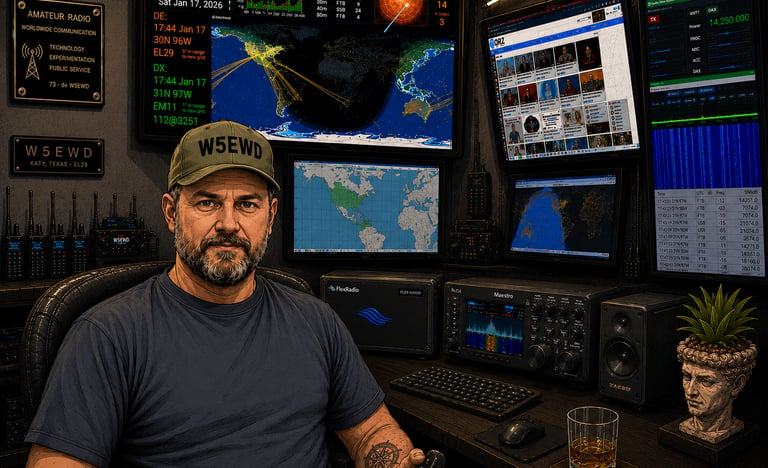
I've really enjoyed POTA, setting up a mobile station in my vehicle and am constantly adjusting my home base station. I've been at the same QTH in an HOA for over 10 years now and still have a few more years to go before my kids are done with high school and the wife and I can move out to a more rural location where I'm sure I will have a massive antenna farm (wink wink). I've had many, many challenges with getting my home station to a decent operating state; see my troubleshooting page for more deets on that. It's all part of the fun, although a stubborn issue can be very frustrating, especially right when you get into the hobby.
One of the things I appreciate most about amateur radio is that no one ever fully “finishes” learning . Every operator has different experiences, different environments, and different solutions. Except sad hams. Sad hams know everything already...
One of my biggest regrets in life is not getting into amateur radio sooner.
Why I Built This Website
I created this site as a place to document my projects, experiments, successes, failures, and lessons learned along the way.
A lot of technical hobbies online only show the polished final result. I wanted this site to include the real process:
what worked
what failed
unexpected problems
troubleshooting steps
changes over time
and how challenges were eventually solved (if ever...)
My hope is that documenting these experiences may help other operators who are working through similar projects or learning the hobby themselves. I really struggled with some of the concepts, even though I should've picked up some of these things with my background a long time ago. I had to piece some things together over time from multiple sources until things 'clicked' for me. I hope to be able to bring light to some of these concepts; but we'll see how this goes, yeah?
Amateur radio has a strong tradition of experimentation and shared knowledge, and I believe the hobby is at its best when operators openly exchange ideas, experiences, and practical lessons learned so that we can all continue learning and enjoying the hobby together.
Write your text here...
Stay Connected
Get updates on antenna builds and projects